
Categories
Phoenix Development News, Arizona Real Estate AdvicePublished August 22, 2026
Two Major ADOT Freeway Projects Are Reshaping the East Valley: What Buyers and Sellers Need to Know

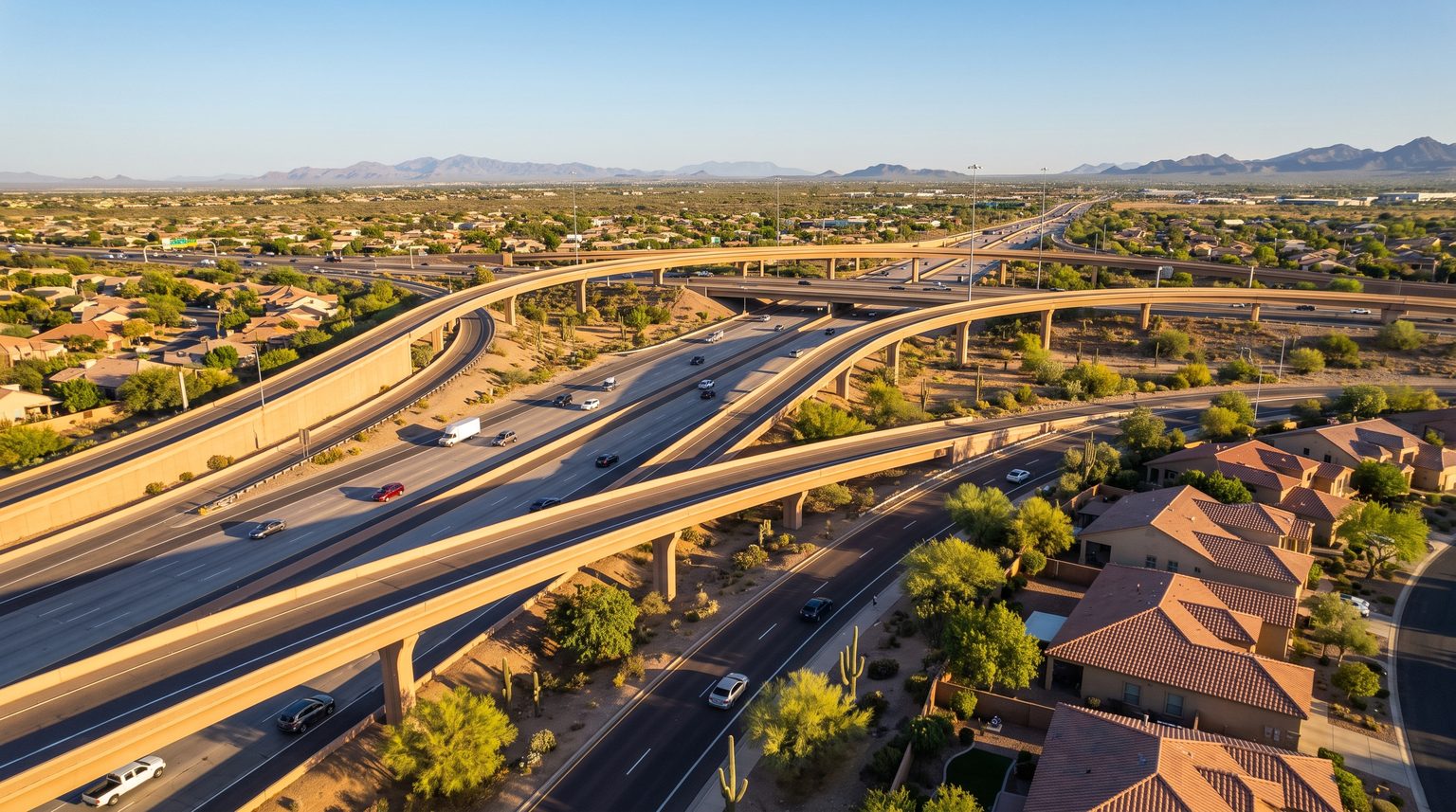
If you live in Chandler, Gilbert, Queen Creek, or anywhere else in the Southeast Valley, two major Arizona Department of Transportation projects are going to change how you get around, and how buyers and sellers should think about the communities along these corridors.
Here's what's happening, when it's happening, and what it means if you're in the market.
Project 1: Loop 202 Santan Freeway Widening, Chandler and Gilbert
What's being built: ADOT is adding lanes to an 8-mile stretch of the Loop 202 Santan Freeway between the Loop 101 interchange in Chandler and Val Vista Drive in Gilbert. Between Loop 101 and Gilbert Road, two lanes are being added in each direction. From Gilbert Road to Val Vista Drive, one lane is added in each direction.
That's not just paint on the freeway. The project also includes:
- Bridge widenings at Arizona Avenue and Lindsay Road
- Full reconstruction of the eastbound Arizona Avenue on-ramp and overpass
- New noise walls and retaining walls
- A two-lane exit ramp replacing the existing single-lane exit
- Upgraded freeway lighting, drainage, signage, and fiber-optic camera infrastructure
Timeline: Construction started in August 2024. ADOT's current estimate puts completion in spring 2027. The project hit its halfway milestone in mid-2025 and is on track.
Who's funding it: Proposition 400, the Maricopa County half-cent sales tax voters approved in 2004 for regional transportation. The project is a joint effort between ADOT and the Maricopa Association of Governments (MAG). Cost is estimated around $200 million.
Why it matters for Chandler and Gilbert buyers: The Loop 202 corridor between Loop 101 and Val Vista Drive is one of the most congested stretches in the East Valley. Chandler's tech and semiconductor job cluster, including Intel's massive Fab 52 expansion, sits at the western end of this segment. Gilbert's residential neighborhoods sit along the eastern end. Right now, the commute between them gets ugly in both directions during peak hours.
After spring 2027, it gets materially better. For buyers choosing between Gilbert and other East Valley suburbs, improved Loop 202 access is a direct commute-quality benefit, not just for today's drive times, but for the next 10 to 20 years as Maricopa County's population continues to grow.
Construction disruption note: Until spring 2027, expect regular weeknight and weekend lane and ramp closures along this corridor. If you're buying in this area now, factor that into your day-to-day commute planning through completion.
Project 2: State Route 24 (Gateway Freeway), From Loop 202 to Ironwood Drive
What's being built: SR-24, the Gateway Freeway, currently runs from the Loop 202 interchange in Gilbert/Chandler east toward the Mesa Gateway Airport area. The problem: it's not fully a freeway yet. It has at-grade intersections with traffic signals, which limits throughput and creates conflict points. This $350 million project fixes that.
ADOT's design phase wrapped up in summer 2026. The project will:
- Add two general-purpose lanes in each direction from Loop 202 to Williams Field Road
- Add one lane in each direction from Williams Field Road to Ironwood Drive
- Construct 11 new grade-separated bridges over Williams Field, Crismon, Signal Butte, and Meridian Roads, eliminating the signalized at-grade crossings entirely
- Convert the Ironwood Drive interchange to a Diverging Diamond Interchange (DDI) design for improved throughput
- Build new interchanges at Williams Field, Signal Butte, and Meridian Roads
- Add sound walls (up to 16 feet) along the north side of the corridor from east of Ellsworth Road to 222nd Street
Timeline: Construction is expected to start in late 2026, with a projected completion in mid-2029. Construction duration is approximately 2.5 years.
Who's funding it: $350 million total (approximately $265 million in construction costs). Funded through federal transportation funds and Proposition 479, the new Maricopa County transportation half-cent sales tax voters approved in 2024, the successor to Prop 400.
Why it matters for Queen Creek, San Tan Valley, and southeast Gilbert: SR-24 is the primary freeway spine connecting communities east of the 202 to the broader East Valley job market. Right now, that connection has stoplights in it. After mid-2029, it won't.
For buyers considering Queen Creek or San Tan Valley, the SR-24 upgrade is one of the most meaningful infrastructure improvements they can be aware of. The commute friction these communities carry, the reason they're priced more affordably than Chandler or Gilbert proper, is partly a function of road infrastructure. A fully grade-separated SR-24 changes that equation.
It's worth noting that SR-24 currently terminates at Ironwood Drive in Maricopa County. The planned extension into Pinal County (the Central Arizona Parkway corridor) is a separate, longer-range project, not part of this build. But the fact that ADOT and Maricopa County are investing $350 million in this segment signals continued long-term commitment to this corridor.
What This Means for East Valley Real Estate
Infrastructure improvements don't guarantee home value increases, the relationship is more nuanced than that. Research on freeway corridors in similar Arizona markets suggests that homes in the broader access zone tend to benefit from improved mobility, while homes immediately adjacent to a freeway may experience a noise/visual discount. Buyers who are right next to a freeway wall pay a different price than buyers one mile away who enjoy the commute benefit without the noise impact.
A few practical points for buyers and sellers thinking about these corridors:
For buyers in Chandler and Gilbert near Loop 202: You're buying into a corridor that's already a seller's market (Chandler's market balance index is firmly seller-side as of August 2026). The widening doesn't change the supply picture, but it does reduce the commute tax for the Chandler tech employment corridor. That's a durable demand driver.
For buyers considering Queen Creek or southeast Gilbert near SR-24: You're buying ahead of a freeway upgrade that won't deliver until mid-2029. That's a meaningful lag. If commute time is your main friction point, build the current commute reality into your decision, and treat the SR-24 improvement as a medium-term upside, not an immediate one.
For sellers in the SR-24 corridor: The project is now funded, designed, and moving toward construction. That's a legitimate infrastructure talking point for marketing a listing, as long as it's presented accurately (under construction, not complete; Maricopa County only, not extending to Pinal County yet).
The Bigger Picture
Both of these projects are direct responses to Southeast Valley growth. Maricopa County's population is projected to grow nearly 30 percent between 2020 and 2040, according to ADOT's own project documentation. These freeways aren't getting wider because someone had spare budget, they're getting wider because the demand is there and growing.
For buyers doing a long-horizon analysis of where to live in the East Valley, infrastructure investment is one of the more reliable signals of sustained regional confidence. Prop 400 funded the last generation of freeway capacity. Prop 479, passed in 2024, is funding the next one.
Thinking about buying or selling in Chandler, Gilbert, Queen Creek, or anywhere in the Southeast Valley? I work this market every day and can help you think through how infrastructure, commute access, and local demand all connect to your specific situation. Get your home’s current value or Search East Valley homes.
This post is for informational purposes only and does not constitute financial or investment advice. Infrastructure timelines are subject to change; verify current project status at azdot.gov before making decisions based on them.

Ryan Melville
| SoldPHX - Ryan Melville at Keller Williams Realty Phoenix
or another way